
Why a Vintage Cartier Tank Watch Still Stands Out
A vintage Cartier Tank watch pairs a slim rectangular case with a design that has stayed recognizable for more than a century. For a more accessible starting point, look at a gold-vermeil Tank Must. For a solid-gold classic, explore the Tank Louis Cartier. Before buying either, check the dial, case markings, movement, and service history. Replacement parts can affect both value and appeal.
Louis Cartier designed the Tank in 1917, drawing its strong lines from the shape of a military tank. Since then, the design has grown into a family of watches, from the curved Cintrée to the bracelet-style Française.
I'm Rhea Wadhwani, Head of Sales Operations at Jewels in Paradise, where I oversee product sourcing and follow luxury watch trends. That experience informs this cartier tank watch vintage guide and the buying details we'll explore next.
The Origins and Century-Long History of the Cartier Tank
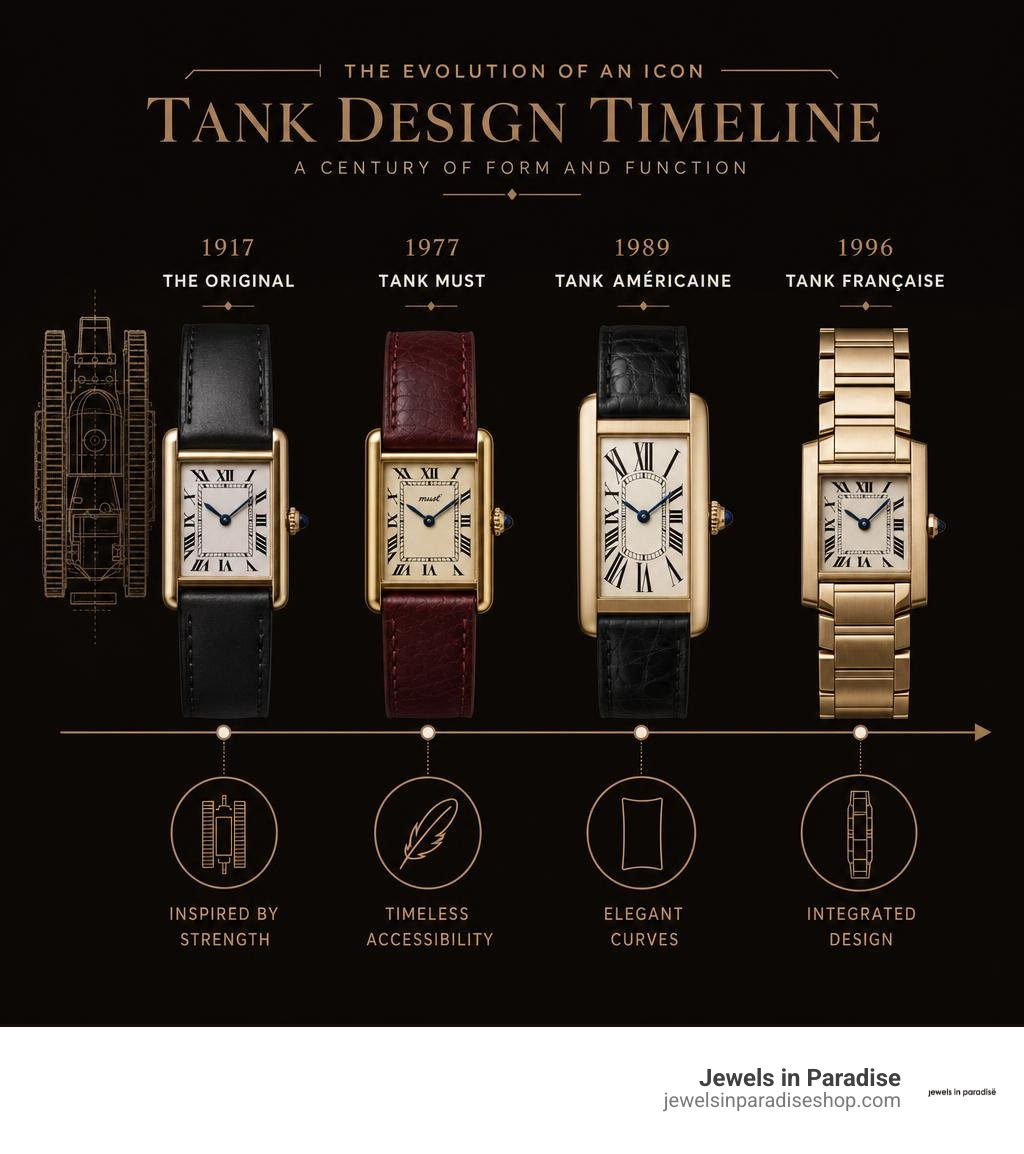
The story of the Cartier Tank begins amidst the turbulence of World War I. In 1917, Louis Cartier found unexpected inspiration in the clean, brutalist machinery of the Renault FT-17 tank, a French military vehicle whose top-down silhouette featured parallel caterpillar tracks flanking a central cockpit. Translating this functional architecture into haute horlogerie, Cartier created a watch case where the vertical side bars—known as brancards—seamlessly integrated the strap attachments into the case body.
Cartier presented one of the earliest prototypes to General John J. Pershing, commander of the American Expeditionary Forces in Europe, cementing the timepiece’s status as a symbol of valor, intellect, and refined taste. When the Tank officially entered commercial production in 1919 with the release of the Tank Normale, it shattered the prevailing pocket-watch-derived aesthetic of round timepieces.
The Tank pioneered the Art Deco visual language long before the movement achieved mainstream global adoption. Its fundamental design codes remain instantly identifiable:
- The Brancards: Parallel vertical shafts framing the dial while serving as lugs.
- Roman Numeral Layout: Bold, radiating Roman numerals featuring a railroad track minute counter (chemin de fer).
- Blued Steel Hands: Elegant sword-shaped or Breguet-style hands heat-blued to an iridescent sheen.
- Sapphire Cabochon: A smooth, polished sapphire or spinel set neatly into the beaded winding crown.
The Distinctive Hallmarks: Cartier Paris, London, and New York
During the golden era of the 20th century, Cartier operated not as a single consolidated corporate entity, but as three independent maisons managed by Louis, Jacques, and Pierre Cartier across Paris, London, and New York. This geographic independence created distinct stylistic footprints that seasoned collectors prize today.
- Cartier Paris (Rue de la Paix): Recognized as the cradle of refined proportion and classical elegance. Paris pieces often feature the word "Paris" neatly printed beneath the 6 o'clock marker. These models embody French pedigree and pure, traditional symmetry.
- Cartier London (New Bond Street): Led by Jean-Jacques Cartier in the swinging 1960s and 1970s, the London workshop (producing cases with famed workshop Wright & Davies) became celebrated for bold, idiosyncratic, and bespoke interpretations. London Tanks feature uniquely exaggerated proportions, warm hand-finished cases, and rare London signatures that achieve staggering results at international auctions.
- Cartier New York (Fifth Avenue): Catering to prominent American industrial titans and socialites, Cartier New York produced approachable luxury, often utilizing 14k gold alongside 18k alloys to navigate American import tariffs. Their dial fonts and case stampings carry distinct serial classifications that tell a rich chapter of mid-century transatlantic society.
Cultural Iconography: Legendary Figures and Provenance
Few objects in modern history have crossed creative fields and cultural eras as fluidly as the vintage Cartier Tank. It has graced the wrists of artists, political leaders, and screen icons:
- Rudolph Valentino: The silent film heartthrob insisted on wearing his personal Cartier Tank throughout the filming of the 1926 cinematic classic The Son of the Sheik, marking one of the earliest instances of high-end horological product placement.
- Andy Warhol: The pop-art visionary famously stated, "I don't wear a Tank to tell the time. In fact, I never wind it. I wear a Tank because it's the watch to wear."
- Princess Diana: Her classic yellow gold Tank Française and Tank Louis models epitomized relaxed elegance, shaping royal style throughout the 1980s and 1990s.
- Jacqueline Kennedy Onassis: Her 1962 18k gold Cartier Tank—gifted by her brother-in-law Prince Stanislaw Radziwill—sold at a historic auction for a remarkable $379,500, underscoring the enduring power of historical provenance.
Complete Guide to Every Cartier Tank Watch Vintage Family
Over its century-long production run, Cartier has developed several sub-families within the Tank lineage. While modern enthusiasts often compare these classic rectangular profiles to traditional round references like Rolex watches, the Tank offers a completely different, geometry-first approach to vintage horology.
| Tank Family | Debut Year | Signature Case Geometry | Primary Materials | Notable Features |
|---|---|---|---|---|
| Tank Normale | 1919 | Square-proportioned, flat, wide brancards | Yellow Gold, Platinum | Faithful to the 1917 Renault tank blueprint; vintage lapis dial variants |
| Tank Cintrée | 1921 | Elongated, dramatically curved case profile | Yellow Gold, Platinum, White Gold | Ergonomic wrist-hugging curve; ultra-thin profile |
| Tank Chinoise | 1922 | Overlapping horizontal lintels across brancards | Yellow Gold, Platinum | Inspired by traditional Chinese architectural temple gateways |
| Tank Louis Cartier | 1922 | Softened, rounded brancards and slim lugs | 18k Yellow, White, Rose Gold | The quintessential dress Tank; balanced Art Deco proportions |
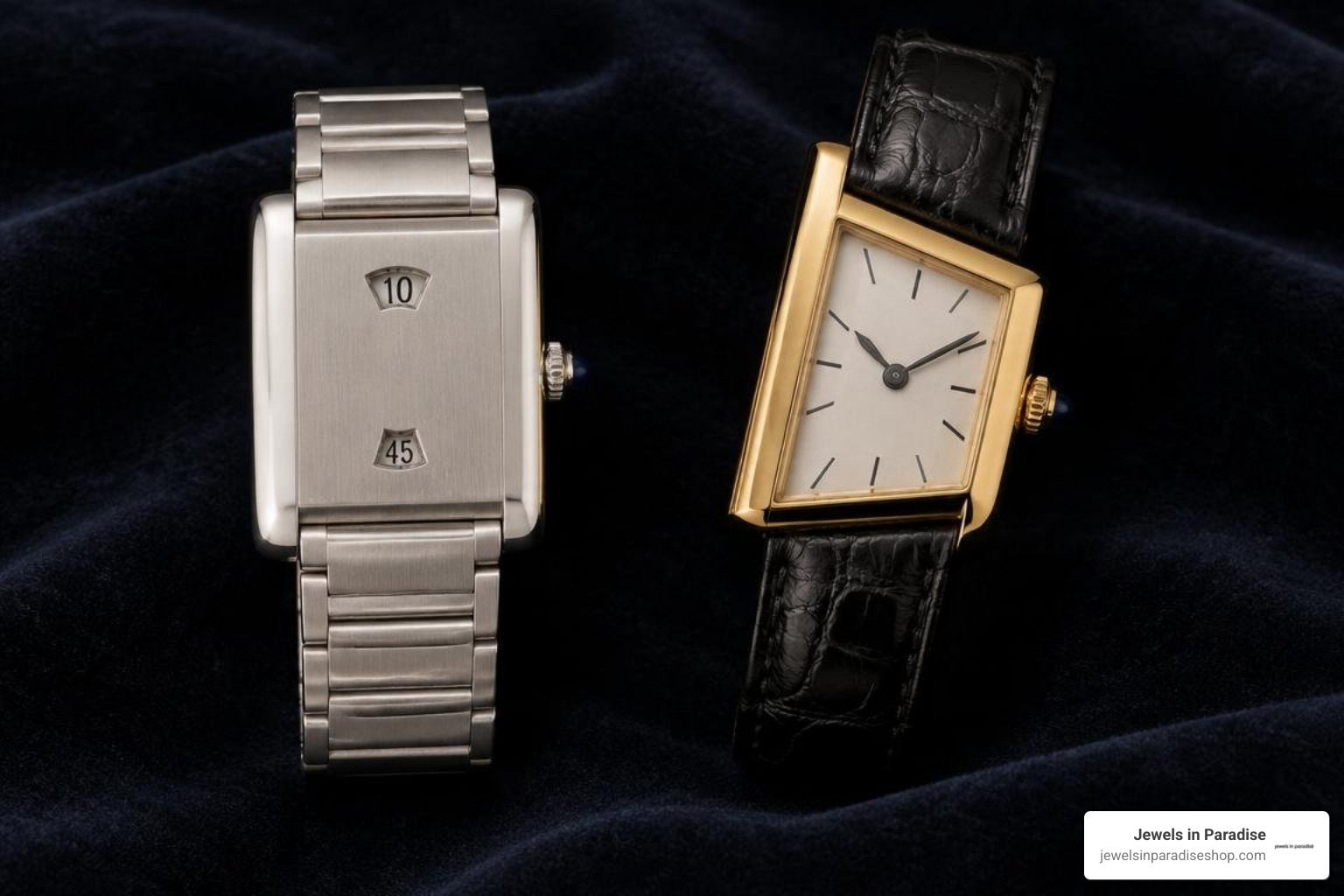
| Tank à Guichets | 1928 | Solid metal front with jumping hour apertures | Platinum, White Gold, Yellow Gold | Digital mechanical display; brushed plate protecting the movement |
| Tank Basculante | 1932 | Tilting inner case rotating 360 degrees | Stainless Steel, Yellow Gold | Reversible case designed to protect the crystal during athletic use |
| Tank Asymétrique | 1936 | Parallelogram case with a 30-degree dial shift | Yellow Gold, Platinum | Angled dial for intuitive reading while holding a vehicle steering wheel |
| Tank Must de Cartier | 1977 | Classic LC proportions in vermeil / silver | Gold Vermeil, Sterling Silver | Vivid colored lacquer dials, mechanical and quartz calibers |
| Tank Américaine | 1989 | Elongated, curved, pronounced modern case | Yellow Gold, White Gold, Steel | Evolved from the Cintrée with added water resistance and automatic calibers |
| Tank Française | 1996 | Integrated chain-link bracelet, beveled brancards | Stainless Steel, Two-Tone, Gold | Modern architectural sport-dress design |
Iconic Core Lines: Normale, Louis Cartier, and Cintrée
The bedrock of any vintage Cartier collection centers on three fundamental silhouettes. The Tank Normale reflects the original 1917 design, featuring flat, industrial brancards and bevel-cut mineral crystals. In vintage markets, rare executions—such as a 1973 platinum and white gold Normale with a factory lapis lazuli dial—frequently achieve auction estimates between HKD 500,000 and 1,000,000.
The Tank Louis Cartier (LC), introduced in 1922, introduced softer, rounded contours along the brancards. It remains the gold standard for black-tie elegance. Notable historic sales include a 1965 platinum Tank Louis commanding between CHF 20,000 and 40,000 at auction.
The Tank Cintrée represents a triumph in ergonomic engineering. Produced in small numbers beginning in 1921, its curved case hugs the wrist. A rare platinum Tank Cintrée from circa 1925 commanded USD 279,400 at auction, while another 1925 example sold for CHF 57,500 against an initial pre-sale estimate of CHF 8,000 to 12,000.
The Creative and Rare Variations: Chinoise, Basculante, and à Guichets
Beyond the core models, Cartier designed avant-garde variations that fetch strong prices on the secondary market:
- Tank Chinoise (1922): Designed during the height of Western fascination with Eastern art, incorporating bold horizontal structural bars resembling architectural lintels. A vintage 1930 18k gold Chinoise regularly achieves auction valuations between CHF 58,000 and 115,000.
- Tank Basculante (1932): Designed with a swivel mechanism that flips the central dial module entirely face-down to shield the crystal.
- Tank à Guichets (1928): A minimalist jumping-hour masterpiece featuring a solid metal face with dual aperture windows for hour digits and wandering minutes. In 2024, a rare white gold Tank à Guichets achieved $450,000 at auction, while a limited edition of 150 pieces sold for HKD 1,386,000.
- Tank Asymétrique (1936): Featuring an oblique parallelogram case where 12 o'clock sits in the upper right corner. A limited-edition platinum reference (No. 98/100) realized HKD 437,500 at auction.
What Defines a Tank Must de Cartier?
In the late 1970s, during the quartz revolution, Cartier introduced the Must de Cartier line. Designed to welcome a new generation of collectors without diluting the prestige of solid-gold pieces, the Tank Must utilized vermeil—solid 925 sterling silver electroplated with a 20-micron layer of yellow gold.
These watches featured playful, minimalist dial treatments free of traditional Roman numerals, including rich burgundy, deep onyx, vibrant lapis blue, warm coral, and striped three-gold dials (Trinity). Powered by both manual-wind calibers (ETA-derived Cartier Calibre 78-1) and practical quartz movements, the vintage Must series remains an accessible entry point into vintage Cartier collecting.
Precious Metals, Rarity, and Market Valuation
Precious metal composition plays a direct role in rarity, weight, and valuation for vintage Cartier Tanks.
Metallurgy and Valuation of a Vintage Cartier Tank Watch
Collectors who appreciate white-metal luxury watches—such as a fine Rolex 125719BLRO GMT-Master II Oyster 40 mm White Gold—often discover that mid-century white-metal Cartier dress watches are exceptionally rare.
Throughout the mid-20th century, Cartier produced yellow-gold cases in far greater quantities than white gold or platinum. Consequently, finding an unpolished 1960s Tank Louis in platinum or an early white-gold Cintrée is a major collecting event. Fine vintage pieces can occasionally carry specialized complications; for instance, a rare Tank Américaine featuring a sapphire-set automatic movement carries auction estimates of HKD 1,000,000 to 2,000,000.
Price Ranges Across the Vintage Spectrum
- Entry Tier ($1,000 – $3,000): Vintage Tank Must de Cartier in gold vermeil, small mechanical or quartz calibers, alongside early stainless-steel Tank Française models.
- Mid Tier ($4,000 – $15,000): Solid 18k yellow gold Tank Louis Cartier from the 1970s–1990s, mechanical Tank Basculante editions, and modern classic Tank Américaine references.
- Collector Tier ($15,000 – $50,000): 1950s–1960s Paris-dialed Tank Louis Cartier, rare manual-wind Jumbo Tank Automatique references, and limited Collection Privée Cartier Paris (CPCP) editions.
- Museum / Grail Tier ($50,000 – $450,000+): Pre-war Tank Cintrée, 1930s Tank Chinoise, jumping-hour Tank à Guichets, and documented single-owner provenance pieces.
Collector’s Guide: Authentication and Preservation
Because vintage Cartier watches are so desirable, collectors should look closely at every detail when evaluating a prospective piece.
How to Spot Common Pitfalls When Buying a Vintage Cartier Tank Watch
- The "Secret Signature": Introduced in the late 20th century to deter counterfeiting, Cartier integrated micro-printed text within the stroke of the VII or X Roman numerals (spelling out "CARTIER"). Many early pre-1970s vintage references legitimately do not feature this secret signature; its absence on a 1950s piece is historically correct, while its absence on a 1990s piece warrants scrutiny.
- Refinished and Redialed Faces: Dials that have been reprinted often display thick lettering, uneven spacing in the chemin de fer minute track, or improper alignment of the "SWISS" or "PARIS" designations at 6 o'clock.
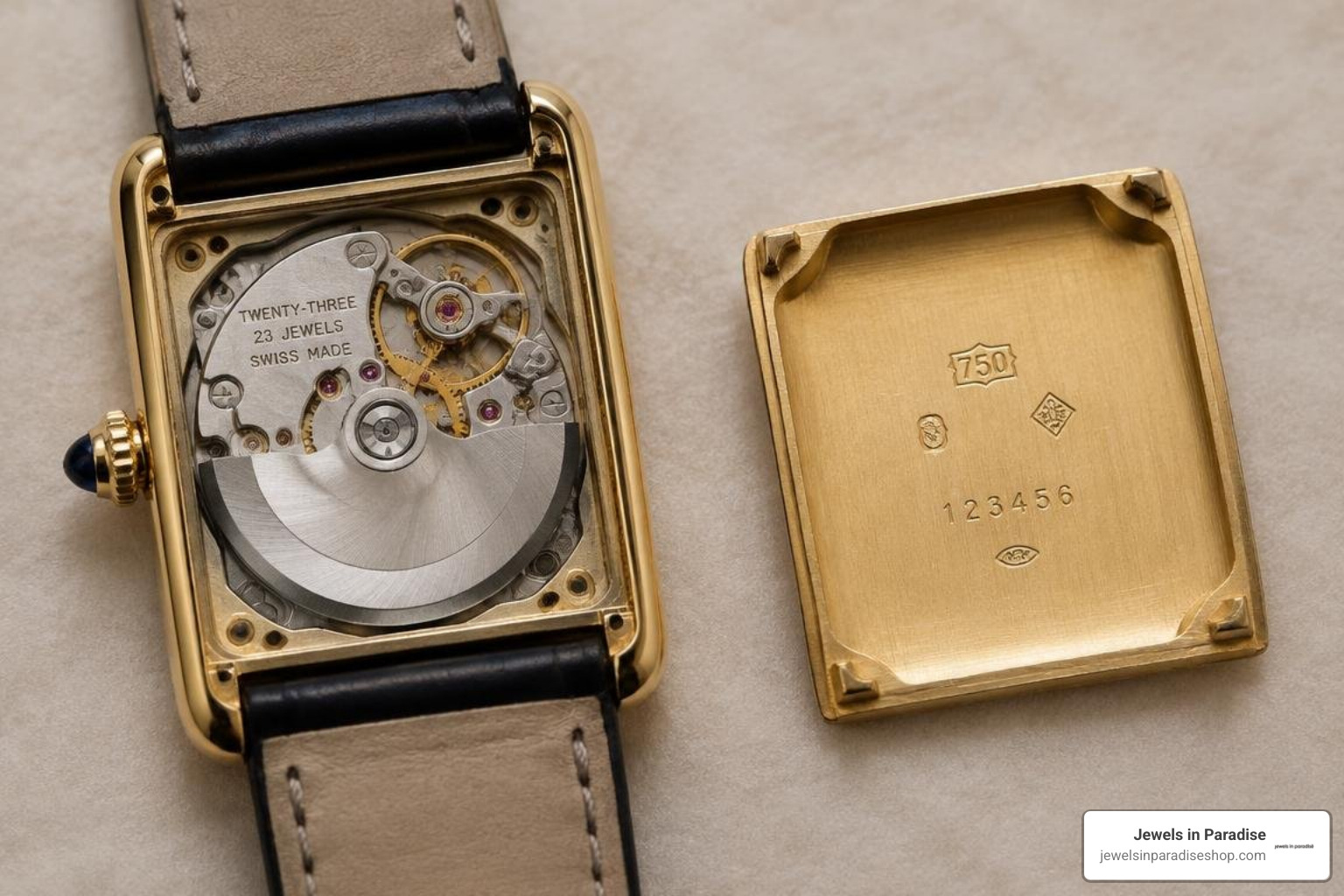
- Frankenwatches and Mismatched Parts: Ensure the case back serial numbers match the production era. Verify that the winding crown features a genuine, hand-set cabochon rather than a modern synthetic glued-in replacement.
- Movement Authenticity: Vintage Cartier mechanical watches utilized high-grade movements supplied by prestigious partners, including European Watch and Clock Co. (EWC), Jaeger-LeCoultre, Frederic Piguet, and ETA. Verify movement signatures and bridge finishing before acquiring a piece.
Maintenance and Servicing for Historic Timepieces
- Movement Care: Mechanical movements require regular cleaning and lubrication every 3 to 5 years by a specialist trained in historic calibers.
- Case Preservation: Avoid aggressive polishing. The sharp bevels and crisp factory hallmarks on the reverse of the brancards are vital to the watch's historical and commercial value.
- Moisture Precautions: Vintage Tank cases are not water-resistant. Keep historic dress watches away from water, steam, and excessive humidity.
- Strap Pairing: Pair your vintage Tank with an ethically sourced, handcrafted leather strap in alligator, calfskin, or Epsom leather to highlight the warm tones of the case.
Frequently Asked Questions About Vintage Cartier Tank Watches
How can you tell if a vintage Cartier Tank is authentic?
Authenticating a vintage Tank requires examining the typography, case hallmarks, and internal movement. Authentic dials feature crisp, razor-sharp serif typography across the Roman numerals, symmetrical chemin de fer tracks, and period-correct maker marks ("PARIS", "SWISS", or "SWISS MADE"). The reverse should exhibit clean, sharp reference and serial punch marks alongside appropriate precious metal assay stamps (such as the French Eagle's head or Swiss Helvetia hallmark). The internal movement must feature correct period-accurate factory engravings.
What is the primary difference between a Tank Louis and a Tank Must?
The primary differences lie in case composition, dial execution, and intended market position:
- Tank Louis Cartier: Crafted exclusively from solid 18k precious metals (yellow, white, or rose gold and platinum), featuring softened, rounded brancards, classic white or cream Roman dials, and primarily fine mechanical calibers.
- Tank Must de Cartier: Introduced in 1977 featuring a case built from gold vermeil (sterling silver coated in gold) or solid stainless steel, often fitted with colorful minimalist lacquer dials and driven by both mechanical and quartz movements.
Why are Cartier London Tank watches so highly valued by collectors?
Cartier London watches produced under Jean-Jacques Cartier between the 1960s and 1970s were manufactured independently at the New Bond Street workshop with cases produced by Wright & Davies. Because these pieces were manufactured in limited quantities, often as bespoke commissions with unique, elongated, and sculptural proportions, they are among the rarest and most desirable Cartier timepieces at auction.
Conclusion
The vintage Cartier Tank has maintained its appeal for more than a century by staying true to its original design vision. From early Art Deco mechanical references to colorful 1970s Must models, it remains a cornerstone of classic horology.
Whether you are seeking a rare white-metal dress watch or building a varied collection that includes iconic models like the Rolex Unworn Submariner Watch, Rolex Oyster Perpetual 36mm 126000-0005 Green Dial, or classic Rolex Datejust Watches, we are here to help you discover exceptional timepieces. Explore our collections at Jewels in Paradise to find curated, handcrafted fine jewelry and timepieces backed by attentive service and worldwide insured delivery.
Why a Vintage Cartier Tank Watch Still Stands Out

A vintage Cartier Tank watch pairs a slim rectangular case with a design that has stayed recognizable for more than a century. For a more accessible starting point, look at a gold-vermeil Tank Must. For a solid-gold classic, explore the Tank Louis Cartier. Before buying either, check the dial, case markings, movement, and service history. Replacement parts can affect both value and appeal.
Louis Cartier designed the Tank in 1917, drawing its strong lines from the shape of a military tank. Since then, the design has grown into a family of watches, from the curved Cintrée to the bracelet-style Française.
I'm Rhea Wadhwani, Head of Sales Operations at Jewels in Paradise, where I oversee product sourcing and follow luxury watch trends. That experience informs this cartier tank watch vintage guide and the buying details we'll explore next.
The Origins and Century-Long History of the Cartier Tank
The story of the Cartier Tank begins amidst the turbulence of World War I. In 1917, Louis Cartier found unexpected inspiration in the clean, brutalist machinery of the Renault FT-17 tank, a French military vehicle whose top-down silhouette featured parallel caterpillar tracks flanking a central cockpit. Translating this functional architecture into haute horlogerie, Cartier created a watch case where the vertical side bars—known as brancards—seamlessly integrated the strap attachments into the case body.
Cartier presented one of the earliest prototypes to General John J. Pershing, commander of the American Expeditionary Forces in Europe, cementing the timepiece’s status as a symbol of valor, intellect, and refined taste. When the Tank officially entered commercial production in 1919 with the release of the Tank Normale, it shattered the prevailing pocket-watch-derived aesthetic of round timepieces.
The Tank pioneered the Art Deco visual language long before the movement achieved mainstream global adoption. Its fundamental design codes remain instantly identifiable:
- The Brancards: Parallel vertical shafts framing the dial while serving as lugs.
- Roman Numeral Layout: Bold, radiating Roman numerals featuring a railroad track minute counter (chemin de fer).
- Blued Steel Hands: Elegant sword-shaped or Breguet-style hands heat-blued to an iridescent sheen.
- Sapphire Cabochon: A smooth, polished sapphire or spinel set neatly into the beaded winding crown.
The Distinctive Hallmarks: Cartier Paris, London, and New York
During the golden era of the 20th century, Cartier operated not as a single consolidated corporate entity, but as three independent maisons managed by Louis, Jacques, and Pierre Cartier across Paris, London, and New York. This geographic independence created distinct stylistic footprints that seasoned collectors prize today.
- Cartier Paris (Rue de la Paix): Recognized as the cradle of refined proportion and classical elegance. Paris pieces often feature the word "Paris" neatly printed beneath the 6 o'clock marker. These models embody French pedigree and pure, traditional symmetry.
- Cartier London (New Bond Street): Led by Jean-Jacques Cartier in the swinging 1960s and 1970s, the London workshop (producing cases with famed workshop Wright & Davies) became celebrated for bold, idiosyncratic, and bespoke interpretations. London Tanks feature uniquely exaggerated proportions, warm hand-finished cases, and rare London signatures that achieve staggering results at international auctions.
- Cartier New York (Fifth Avenue): Catering to prominent American industrial titans and socialites, Cartier New York produced approachable luxury, often utilizing 14k gold alongside 18k alloys to navigate American import tariffs. Their dial fonts and case stampings carry distinct serial classifications that tell a rich chapter of mid-century transatlantic society.
Cultural Iconography: Legendary Figures and Provenance
Few objects in modern history have crossed creative fields and cultural eras as fluidly as the vintage Cartier Tank. It has graced the wrists of artists, political leaders, and screen icons:
- Rudolph Valentino: The silent film heartthrob insisted on wearing his personal Cartier Tank throughout the filming of the 1926 cinematic classic The Son of the Sheik, marking one of the earliest instances of high-end horological product placement.
- Andy Warhol: The pop-art visionary famously stated, "I don't wear a Tank to tell the time. In fact, I never wind it. I wear a Tank because it's the watch to wear."
- Princess Diana: Her classic yellow gold Tank Française and Tank Louis models epitomized relaxed elegance, shaping royal style throughout the 1980s and 1990s.
- Jacqueline Kennedy Onassis: Her 1962 18k gold Cartier Tank—gifted by her brother-in-law Prince Stanislaw Radziwill—sold at a historic auction for a remarkable $379,500, underscoring the enduring power of historical provenance.
Complete Guide to Every Cartier Tank Watch Vintage Family
Over its century-long production run, Cartier has developed several sub-families within the Tank lineage. While modern enthusiasts often compare these classic rectangular profiles to traditional round references like Rolex watches, the Tank offers a completely different, geometry-first approach to vintage horology.
| Tank Family | Debut Year | Signature Case Geometry | Primary Materials | Notable Features |
|---|---|---|---|---|
| Tank Normale | 1919 | Square-proportioned, flat, wide brancards | Yellow Gold, Platinum | Faithful to the 1917 Renault tank blueprint; vintage lapis dial variants |
| Tank Cintrée | 1921 | Elongated, dramatically curved case profile | Yellow Gold, Platinum, White Gold | Ergonomic wrist-hugging curve; ultra-thin profile |
| Tank Chinoise | 1922 | Overlapping horizontal lintels across brancards | Yellow Gold, Platinum | Inspired by traditional Chinese architectural temple gateways |
| Tank Louis Cartier | 1922 | Softened, rounded brancards and slim lugs | 18k Yellow, White, Rose Gold | The quintessential dress Tank; balanced Art Deco proportions |
| Tank à Guichets | 1928 | Solid metal front with jumping hour apertures | Platinum, White Gold, Yellow Gold | Digital mechanical display; brushed plate protecting the movement |
| Tank Basculante | 1932 | Tilting inner case rotating 360 degrees | Stainless Steel, Yellow Gold | Reversible case designed to protect the crystal during athletic use |
| Tank Asymétrique | 1936 | Parallelogram case with a 30-degree dial shift | Yellow Gold, Platinum | Angled dial for intuitive reading while holding a vehicle steering wheel |
| Tank Must de Cartier | 1977 | Classic LC proportions in vermeil / silver | Gold Vermeil, Sterling Silver | Vivid colored lacquer dials, mechanical and quartz calibers |
| Tank Américaine | 1989 | Elongated, curved, pronounced modern case | Yellow Gold, White Gold, Steel | Evolved from the Cintrée with added water resistance and automatic calibers |
| Tank Française | 1996 | Integrated chain-link bracelet, beveled brancards | Stainless Steel, Two-Tone, Gold | Modern architectural sport-dress design |
Iconic Core Lines: Normale, Louis Cartier, and Cintrée
The bedrock of any vintage Cartier collection centers on three fundamental silhouettes. The Tank Normale reflects the original 1917 design, featuring flat, industrial brancards and bevel-cut mineral crystals. In vintage markets, rare executions—such as a 1973 platinum and white gold Normale with a factory lapis lazuli dial—frequently achieve auction estimates between HKD 500,000 and 1,000,000.
The Tank Louis Cartier (LC), introduced in 1922, introduced softer, rounded contours along the brancards. It remains the gold standard for black-tie elegance. Notable historic sales include a 1965 platinum Tank Louis commanding between CHF 20,000 and 40,000 at auction.
The Tank Cintrée represents a triumph in ergonomic engineering. Produced in small numbers beginning in 1921, its curved case hugs the wrist. A rare platinum Tank Cintrée from circa 1925 commanded USD 279,400 at auction, while another 1925 example sold for CHF 57,500 against an initial pre-sale estimate of CHF 8,000 to 12,000.
The Creative and Rare Variations: Chinoise, Basculante, and à Guichets
Beyond the core models, Cartier designed avant-garde variations that fetch strong prices on the secondary market:
- Tank Chinoise (1922): Designed during the height of Western fascination with Eastern art, incorporating bold horizontal structural bars resembling architectural lintels. A vintage 1930 18k gold Chinoise regularly achieves auction valuations between CHF 58,000 and 115,000.
- Tank Basculante (1932): Designed with a swivel mechanism that flips the central dial module entirely face-down to shield the crystal.
- Tank à Guichets (1928): A minimalist jumping-hour masterpiece featuring a solid metal face with dual aperture windows for hour digits and wandering minutes. In 2024, a rare white gold Tank à Guichets achieved $450,000 at auction, while a limited edition of 150 pieces sold for HKD 1,386,000.
- Tank Asymétrique (1936): Featuring an oblique parallelogram case where 12 o'clock sits in the upper right corner. A limited-edition platinum reference (No. 98/100) realized HKD 437,500 at auction.
What Defines a Tank Must de Cartier?
In the late 1970s, during the quartz revolution, Cartier introduced the Must de Cartier line. Designed to welcome a new generation of collectors without diluting the prestige of solid-gold pieces, the Tank Must utilized vermeil—solid 925 sterling silver electroplated with a 20-micron layer of yellow gold.
These watches featured playful, minimalist dial treatments free of traditional Roman numerals, including rich burgundy, deep onyx, vibrant lapis blue, warm coral, and striped three-gold dials (Trinity). Powered by both manual-wind calibers (ETA-derived Cartier Calibre 78-1) and practical quartz movements, the vintage Must series remains an accessible entry point into vintage Cartier collecting.
Precious Metals, Rarity, and Market Valuation
Precious metal composition plays a direct role in rarity, weight, and valuation for vintage Cartier Tanks.
Metallurgy and Valuation of a Vintage Cartier Tank Watch
Collectors who appreciate white-metal luxury watches—such as a fine Rolex 125719BLRO GMT-Master II Oyster 40 mm White Gold—often discover that mid-century white-metal Cartier dress watches are exceptionally rare.
Throughout the mid-20th century, Cartier produced yellow-gold cases in far greater quantities than white gold or platinum. Consequently, finding an unpolished 1960s Tank Louis in platinum or an early white-gold Cintrée is a major collecting event. Fine vintage pieces can occasionally carry specialized complications; for instance, a rare Tank Américaine featuring a sapphire-set automatic movement carries auction estimates of HKD 1,000,000 to 2,000,000.
Price Ranges Across the Vintage Spectrum
- Entry Tier ($1,000 – $3,000): Vintage Tank Must de Cartier in gold vermeil, small mechanical or quartz calibers, alongside early stainless-steel Tank Française models.
- Mid Tier ($4,000 – $15,000): Solid 18k yellow gold Tank Louis Cartier from the 1970s–1990s, mechanical Tank Basculante editions, and modern classic Tank Américaine references.
- Collector Tier ($15,000 – $50,000): 1950s–1960s Paris-dialed Tank Louis Cartier, rare manual-wind Jumbo Tank Automatique references, and limited Collection Privée Cartier Paris (CPCP) editions.
- Museum / Grail Tier ($50,000 – $450,000+): Pre-war Tank Cintrée, 1930s Tank Chinoise, jumping-hour Tank à Guichets, and documented single-owner provenance pieces.
Collector’s Guide: Authentication and Preservation
Because vintage Cartier watches are so desirable, collectors should look closely at every detail when evaluating a prospective piece.
How to Spot Common Pitfalls When Buying a Vintage Cartier Tank Watch
- The "Secret Signature": Introduced in the late 20th century to deter counterfeiting, Cartier integrated micro-printed text within the stroke of the VII or X Roman numerals (spelling out "CARTIER"). Many early pre-1970s vintage references legitimately do not feature this secret signature; its absence on a 1950s piece is historically correct, while its absence on a 1990s piece warrants scrutiny.
- Refinished and Redialed Faces: Dials that have been reprinted often display thick lettering, uneven spacing in the chemin de fer minute track, or improper alignment of the "SWISS" or "PARIS" designations at 6 o'clock.
- Frankenwatches and Mismatched Parts: Ensure the case back serial numbers match the production era. Verify that the winding crown features a genuine, hand-set cabochon rather than a modern synthetic glued-in replacement.
- Movement Authenticity: Vintage Cartier mechanical watches utilized high-grade movements supplied by prestigious partners, including European Watch and Clock Co. (EWC), Jaeger-LeCoultre, Frederic Piguet, and ETA. Verify movement signatures and bridge finishing before acquiring a piece.
Maintenance and Servicing for Historic Timepieces
- Movement Care: Mechanical movements require regular cleaning and lubrication every 3 to 5 years by a specialist trained in historic calibers.
- Case Preservation: Avoid aggressive polishing. The sharp bevels and crisp factory hallmarks on the reverse of the brancards are vital to the watch's historical and commercial value.
- Moisture Precautions: Vintage Tank cases are not water-resistant. Keep historic dress watches away from water, steam, and excessive humidity.
- Strap Pairing: Pair your vintage Tank with an ethically sourced, handcrafted leather strap in alligator, calfskin, or Epsom leather to highlight the warm tones of the case.
Frequently Asked Questions About Vintage Cartier Tank Watches
How can you tell if a vintage Cartier Tank is authentic?
Authenticating a vintage Tank requires examining the typography, case hallmarks, and internal movement. Authentic dials feature crisp, razor-sharp serif typography across the Roman numerals, symmetrical chemin de fer tracks, and period-correct maker marks ("PARIS", "SWISS", or "SWISS MADE"). The reverse should exhibit clean, sharp reference and serial punch marks alongside appropriate precious metal assay stamps (such as the French Eagle's head or Swiss Helvetia hallmark). The internal movement must feature correct period-accurate factory engravings.
What is the primary difference between a Tank Louis and a Tank Must?
The primary differences lie in case composition, dial execution, and intended market position:
- Tank Louis Cartier: Crafted exclusively from solid 18k precious metals (yellow, white, or rose gold and platinum), featuring softened, rounded brancards, classic white or cream Roman dials, and primarily fine mechanical calibers.
- Tank Must de Cartier: Introduced in 1977 featuring a case built from gold vermeil (sterling silver coated in gold) or solid stainless steel, often fitted with colorful minimalist lacquer dials and driven by both mechanical and quartz movements.
Why are Cartier London Tank watches so highly valued by collectors?
Cartier London watches produced under Jean-Jacques Cartier between the 1960s and 1970s were manufactured independently at the New Bond Street workshop with cases produced by Wright & Davies. Because these pieces were manufactured in limited quantities, often as bespoke commissions with unique, elongated, and sculptural proportions, they are among the rarest and most desirable Cartier timepieces at auction.
Conclusion
The vintage Cartier Tank has maintained its appeal for more than a century by staying true to its original design vision. From early Art Deco mechanical references to colorful 1970s Must models, it remains a cornerstone of classic horology.
Whether you are seeking a rare white-metal dress watch or building a varied collection that includes iconic models like the Rolex Unworn Submariner Watch, Rolex Oyster Perpetual 36mm 126000-0005 Green Dial, or classic Rolex Datejust Watches, we are here to help you discover exceptional timepieces. Explore our collections at Jewels in Paradise to find curated, handcrafted fine jewelry and timepieces backed by attentive service and worldwide insured delivery.